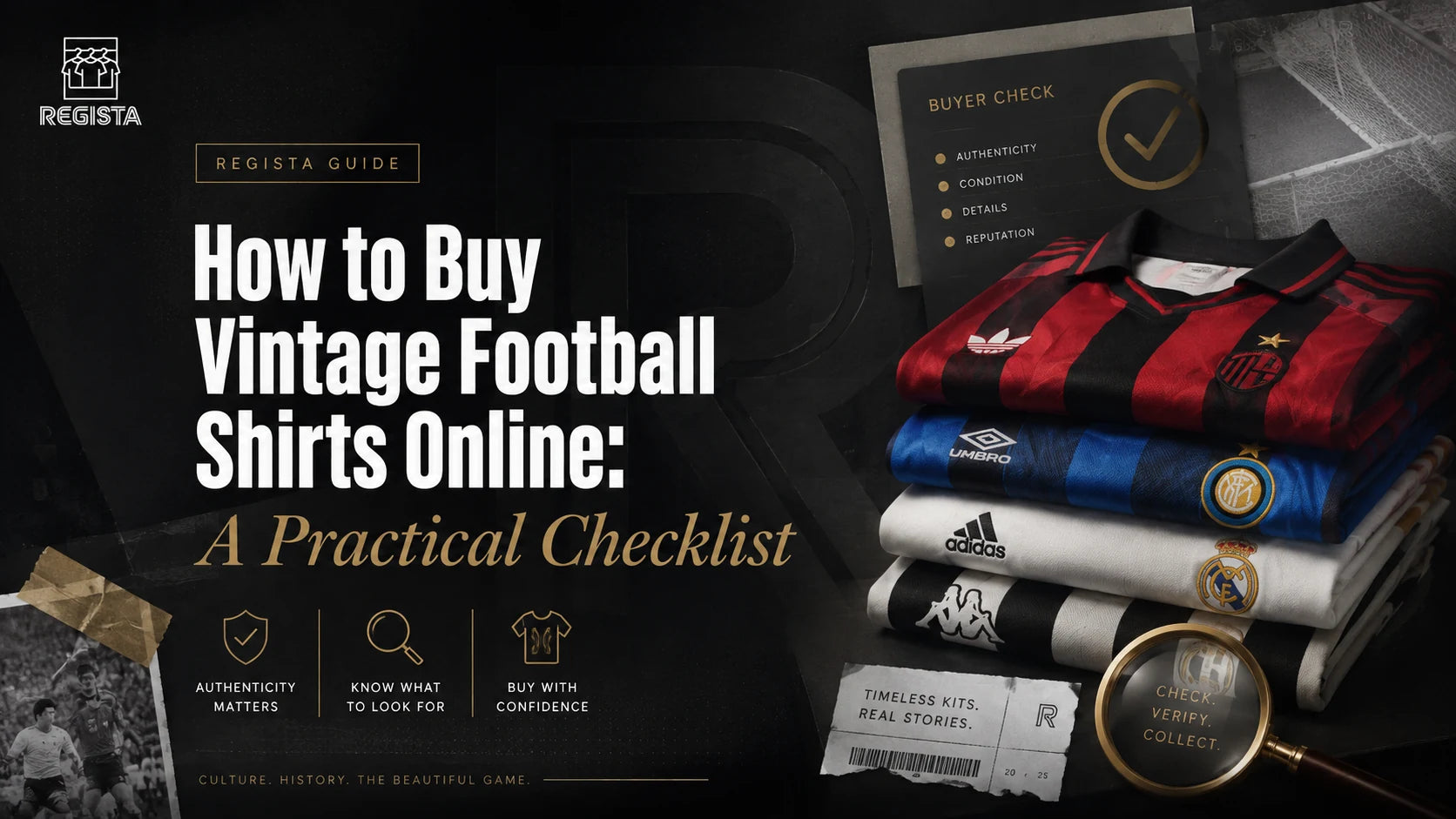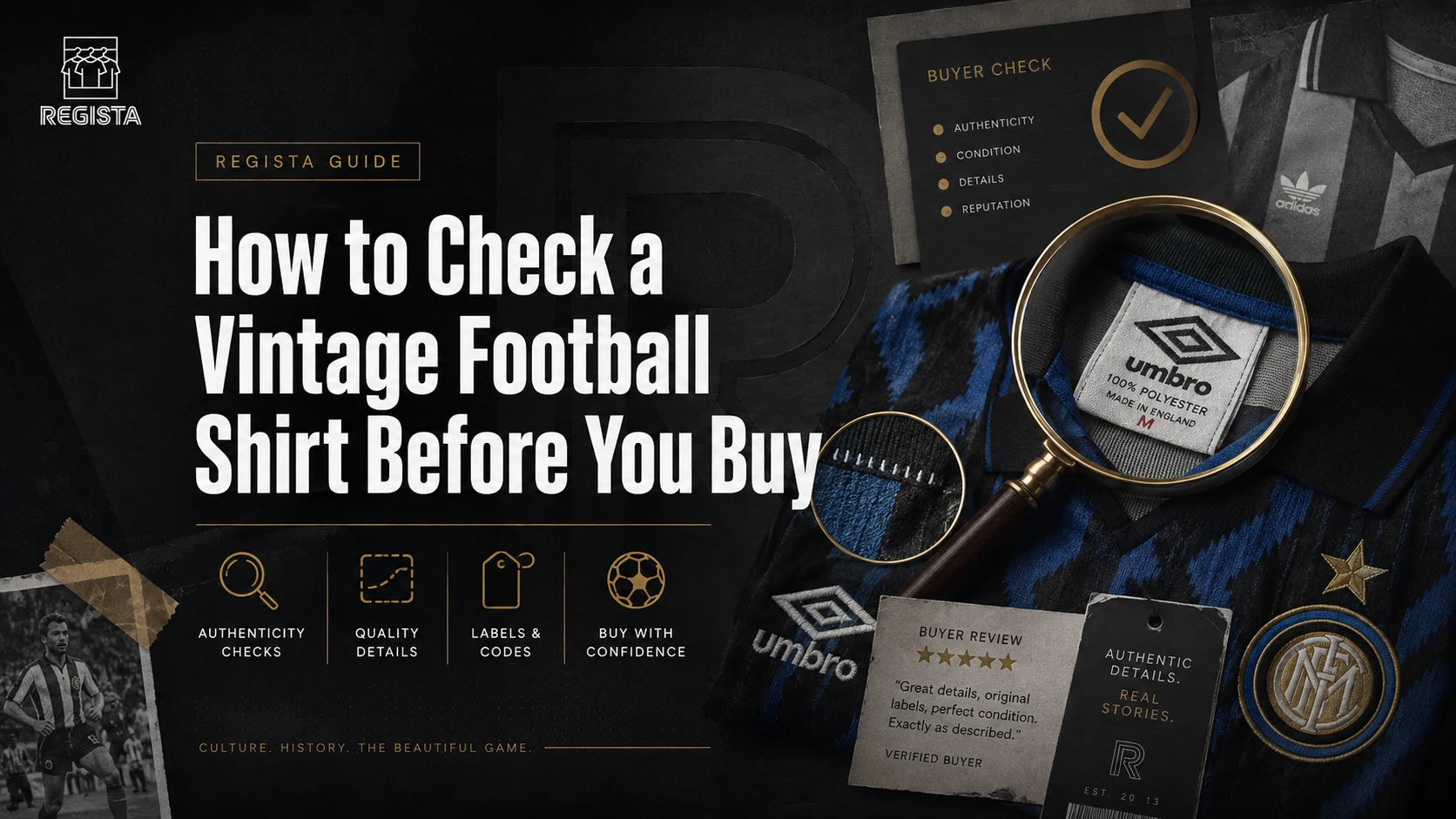

What to inspect in a vintage football shirt listing before buying, from labels and crests to sponsor details, construction and item-specific photos.
Premium guide overview
A better pre-purchase check
This guide helps readers inspect older shirts more carefully before purchase, especially when they need stronger reassurance around authenticity and condition.
Quick checklist
What this guide helps you evaluate
Use these checkpoints as a fast pre-read before going through the full article.
Inspect badge placement and stitching
Zoom into sponsor print and manufacturer logo
Check collar, cuffs and seams for wear
Look at labels and internal codes where available
Make sure era details feel consistent across the shirt
When you are assessing an older football shirt online, the most useful approach is to build a picture from several details. A single label, code or photograph should not carry the entire decision.
Begin with the whole garment
Look at the proportions, panel layout, collar, cuffs, colour blocking and general construction. The shirt should make sense as a complete garment before you zoom in on smaller details.
Inspect labels carefully
Neck and care labels can provide useful information about sizing, materials and production. Product or style codes can also be useful where they exist. However, labels change across manufacturers and eras, so a check that works for one period may not apply to another.
Look at the crest and manufacturer details
Study how the crest and manufacturer mark are applied. Embroidery, woven badges, flock, heat-applied details and other methods can differ by era and model. The important question is whether the construction is consistent with the rest of the garment and with the item being represented.
Check sponsor and player printing
Sponsor ageing is common on older shirts. Look for cracking, lifting, fading or other visible wear. If a name and number are present, inspect them separately from the shirt itself. A shirt and its later-added printing do not necessarily have the same age or condition.
Use close-up photos as evidence
A good listing should let you examine the actual item. Close-ups of labels, badges, printing and any visible flaws are more useful than a single polished front image. If the photographs do not answer an important question, ask for clarification before buying.
Condition and authenticity are different questions
An authentic older shirt can be heavily worn, and a clean-looking shirt is not automatically authentic. Assess condition and authenticity separately. First ask whether the construction and details are consistent; then decide whether the level of wear is acceptable to you.
What Regista checks
Before listing, Regista reviews key labels, crests, sponsor details and construction for consistency. The individual product page then shows the item-specific information available for that piece. If you need a closer look at a label, print, badge or visible mark, contact Regista with the product link.
Do not rely on one shortcut
Internet checklists often present a single feature as a universal answer. Football shirts cover many decades, factories, manufacturers, markets and garment types. A stronger assessment combines the whole garment, its labels, applied details, construction and provenance of the listing.
For more help, see the Regista FAQ or browse the current catalogue to compare item-specific listings.
Regista guide reviewed 29 August 2026. Product availability and individual item condition can change as stock sells.
Editorial comparison
What to inspect and why
Think of the shirt as a system of details that should make sense together.
| Detail | What to inspect | Why it matters |
|---|---|---|
| Badge | Construction, position and finish | Should feel consistent with the shirt and era |
| Sponsor | Material, edges, ageing and placement | Can reveal wear or inconsistencies |
| Labels | Design, wording and internal codes | Useful supporting evidence when readable |
| Seams & stitching | Construction and finish | Helps assess overall consistency |
| Whole garment | Panels, collar, colours and proportions | Prevents over-relying on one small clue |
Authenticity is rarely one magic clue. Confidence comes from several details agreeing with each other.
Reassuring patterns
- Several details look era-consistent
- Labels, badge and garment construction support each other
- Wear looks natural rather than selectively hidden
- Photos allow you to inspect the whole shirt
Reasons to investigate
- One label is presented as absolute proof
- Key areas are never photographed
- The shirt has conflicting era details
- Important claims cannot be checked from the listing
Questions buyers ask
FAQ
Short answers to the questions most relevant to this guide.
Can one product code prove a vintage shirt is authentic?
A product code can be useful evidence, but it should be considered alongside labels, construction, badges, sponsor details and the whole garment.
What if the badge looks slightly different from another shirt online?
Manufacturing, markets and eras can create variation. Compare multiple details rather than making the decision from the badge alone.
Does heavy wear mean a shirt is fake?
No. Condition and authenticity are separate questions. An authentic older shirt can show significant wear.
Regista tip
A smarter way to use this guide
Look for consistency. Authentic older shirts usually make sense as a whole, not just in one isolated detail.
Avoid this
Common mistake to avoid
Relying on a single sign like the neck tag while ignoring the rest of the shirt.
Next step
How to use this on Regista
After reading, compare a few listings side by side and see which one provides the clearest evidence.
Use it to understand what matters most.
Check the exact photos, size and condition.
Make the decision with clearer expectations.
These Regista guides are designed to help with general buying, collecting, sizing and care decisions. For any order decision, use the exact product listing as the source of truth for the item’s photos, size, condition and availability.
Shop
Browse individually listed football shirts
Compare item-specific size, condition and availability across the current catalogue.
Browse all shirtsSupport
Use the guide, then verify the exact product
Need extra reassurance? Check the listing again, then review the FAQ before you order.