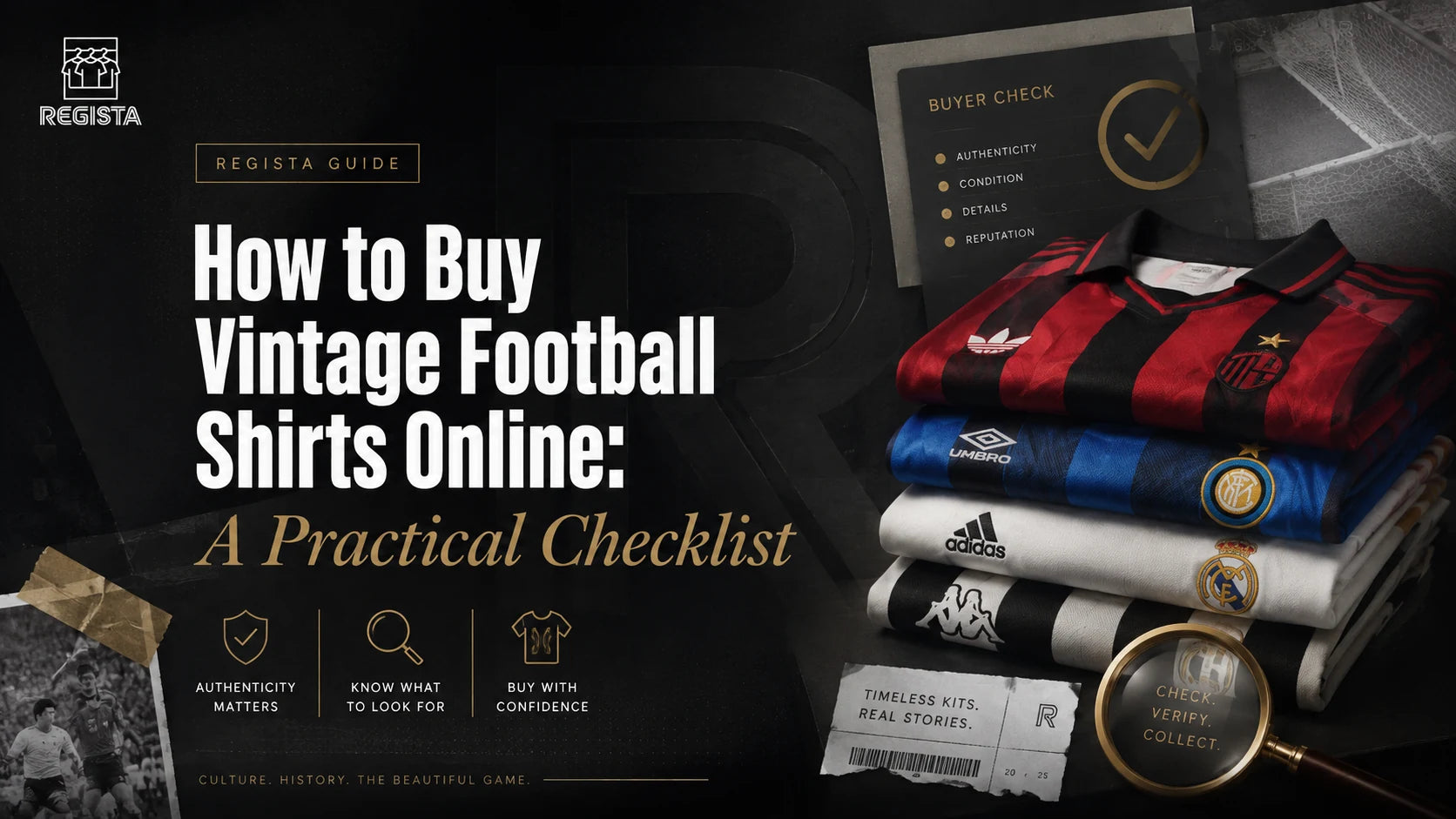
How labels and product codes can help when assessing a football shirt, and why they should be used as part of a wider item check.
Premium guide overview
Decode the details
Labels and product codes can reveal useful clues, but they work best when combined with wider inspection rather than treated as magic proof.
Quick checklist
What this guide helps you evaluate
Use these checkpoints as a fast pre-read before going through the full article.
Check the neck or inner labels carefully
Look for readable product codes where available
Compare label design with the shirt era
Cross-check codes with the rest of the garment
Use labels as one layer of evidence, not the only one
Labels and product codes are useful tools when identifying football shirts, but they are not a universal shortcut. Different manufacturers, factories, markets and eras use different systems.
Start with the care and neck labels
These can show size, material information, production details and manufacturer-specific identifiers. The format can change over time, so compare details within the correct era rather than against a completely different generation of shirt.
What is a product or style code?
Many manufacturers use internal identifiers to distinguish products or styles. Where a code exists and can be reliably matched, it can add useful evidence about what the garment is intended to be. Not every old shirt will present information in the same format.
A matching code is not the whole assessment
Codes should be considered alongside the rest of the garment: crest, manufacturer mark, sponsor, materials, stitching and general construction. A strong assessment is based on several consistent signals.
Be careful with internet databases
Online references can be helpful, but databases may be incomplete or contain user-submitted information. Use them as one source of context rather than replacing examination of the actual item.
Photograph the labels when collecting
If you are building a collection, keeping clear photographs of labels and product details can help you organise what you own and compare future purchases.
Regista's approach
Regista reviews key labels, crests, sponsor details and construction for consistency before listing. If a code or label is important to your decision, ask about the specific product rather than assuming every item carries the same identifiers.
For more buying checks, read how to check a vintage football shirt before buying.
Regista guide reviewed 29 August 2026. Product availability and individual item condition can change as stock sells.
Editorial comparison
What different labels can tell you
Labels can support an assessment, but their usefulness varies by era and manufacturer.
| Label detail | Can help with | Do not assume |
|---|---|---|
| Neck label | Branding, size and era context | That one tag proves authenticity |
| Care label | Materials, manufacturing and product details | Every era uses the same format |
| Product code | Cross-checking a model where codes exist | A readable code is impossible to copy |
| Country of manufacture | Production context | One country automatically means real or fake |
| Size code | Market and fit context | It matches modern sizing exactly |
A product code is a clue. It becomes much more useful when the rest of the shirt tells the same story.
Use labels well
- Compare labels with the garment era
- Use codes as one supporting check
- Look at typography, layout and construction together
- Cross-check with badge, sponsor and fabric
Do not over-read labels
- Treating one code as final proof
- Expecting the same label format across decades
- Ignoring the rest of the garment
- Assuming country of manufacture proves anything alone
Questions buyers ask
FAQ
Short answers to the questions most relevant to this guide.
Do all football shirts have useful product codes?
No. Product-code systems vary across manufacturers and eras, so older shirts may not offer the same type of code as modern shirts.
Can counterfeit shirts copy product codes?
Yes. That is why codes should be used as supporting evidence rather than a single proof point.
What should I compare with the label?
Compare the label with the shirt’s era, construction, badge, sponsor, fabric and overall design.
Regista tip
A smarter way to use this guide
The best approach is label plus fabric, badge, sponsor and overall construction.
Avoid this
Common mistake to avoid
Treating one code or one tag as absolute proof without checking the rest of the shirt.
Next step
How to use this on Regista
When reviewing a listing, use label photos to strengthen or weaken your confidence, then continue checking the bigger picture.
Use it to understand what matters most.
Check the exact photos, size and condition.
Make the decision with clearer expectations.
These Regista guides are designed to help with general buying, collecting, sizing and care decisions. For any order decision, use the exact product listing as the source of truth for the item’s photos, size, condition and availability.
Shop
Browse individually listed football shirts
Compare item-specific size, condition and availability across the current catalogue.
Browse all shirtsSupport
Use the guide, then verify the exact product
Need extra reassurance? Check the listing again, then review the FAQ before you order.